Humans can understand the 3D structure of scenes even from highly unfamiliar or extreme viewpoints. Cognitive science suggests this generalization stems from a top-down generative inference strategy.
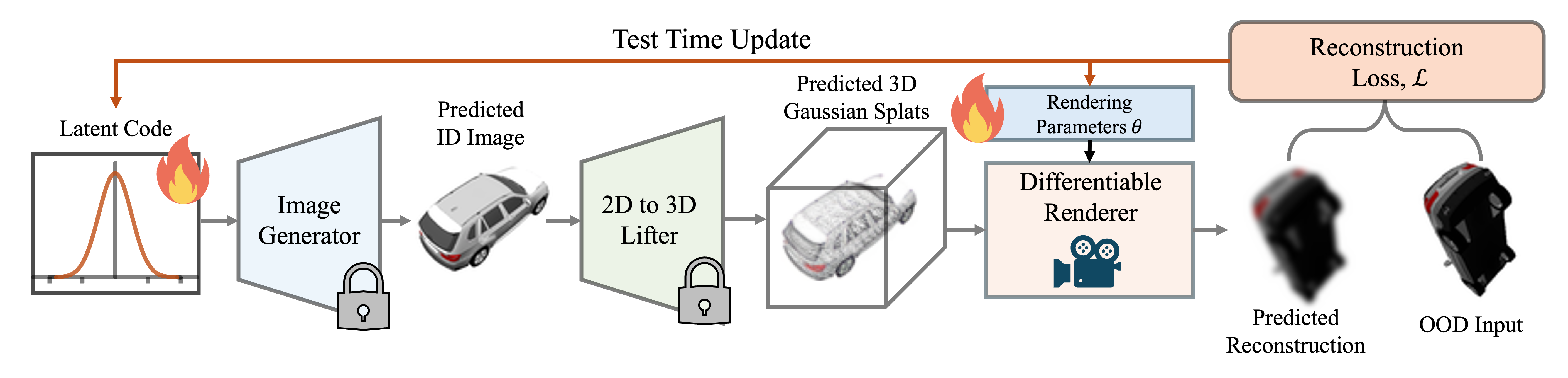
In contrast, state-of-the-art 3D reconstruction neural networks typically rely on amortized, feedforward inference. While fast, this pattern-matching approach degrades when faced with out-of-distribution (OOD) scene conditions unseen during training. Inspired by the generative nature of human vision, we propose Infer3D, an inverse generative modeling framework that recovers the latent variables of a generative model to best match the monocular input. To prevent degenerate flat outputs, we couple the generative image prior with a frozen 3D lifting network that constrains the optimization space to a valid, multi-view-consistent 3D manifold.
Across a variety of controlled synthetic and real-world tasks, Infer3D demonstrates superior OOD reconstruction accuracy compared to feedforward networks trained on equal or larger datasets. Furthermore, mirroring how human perception requires more time to process confusing stimuli, we introduce an adaptive inference strategy that expends more test-time compute on ambigious OOD examples while efficiently routing in-distribution inputs.